Products
Products
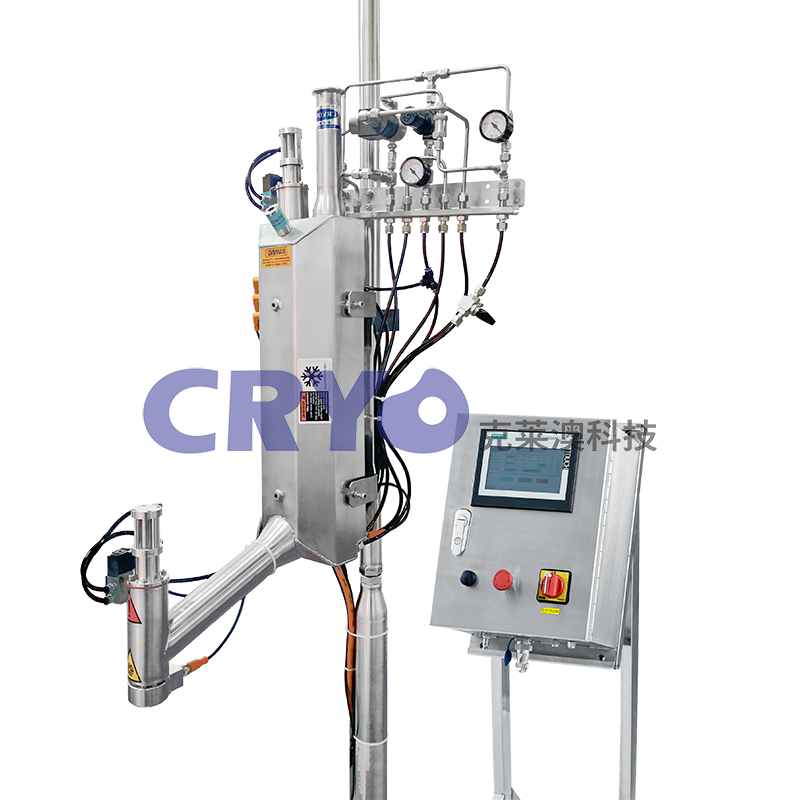
CRYOVBS-200
Features
- Nitrogen positive pressure protection - The nozzle adopts dry nitrogen positive pressure protection to prevent external air from entering and causing frost and ice blockage inside the nozzle
- The exhaust port is discharged from the top and connected to the outside through a vacuum tube (optional)
- Adopting differential pressure level gauge - high liquid level accuracy, the tank body has gas-liquid separation function, achieving pressure free filling
- Accurate nitrogen injection - providing stable and accurate nitrogen injection
- Individual refueling - interval refueling mode below 300CPM
- Individual or continuous refueling - the speed of changing refueling modes can be set by the user themselves
- Vacuum insulation technology - improving the efficiency of liquid nitrogen use
- Soft filling compatibility - suitable for hot filling, powder, and granular, edible oil products
- Micro injection technology - the consistency and accuracy of nitrogen injection cover all line speeds
Principle
Liquid nitrogen is first transported from the storage tank to the nitrogen injection head of the filling machine through a vacuum insulated tube. The first sensor (which can also be used as an encoder to improve the resolution of bottle speed sensing) detects the speed of the assembly line, and the second sensor senses the presence of the container. The system calculates the required amount of liquid nitrogen injection based on the container speed (speed automatic filling compensation function). Once the presence of the container is sensed, the predetermined amount of liquid nitrogen is opened under the filling valve. The entire nitrogen injection process is comprehensively controlled by a programming logic controller, sensors, and a human-machine interface.
Advantages
-
Lightweight PET bottles
Reduce the weight of PET, save costs and promote environmental protection
-
Glass to plastic packaging
Eliminate the personal hazards of glass bottles and reduce product weight
-
Bottle tightness
Maintain the original posture of the lightweight bottle
-
Eliminate flat bottles
Increase bottle pressure to eliminate flat bottle problems
-
Low oxygen function
Inert packaging maintains product freshness
-
Extend shelf life
The oxygen content drops to the lowest level
-
Easy to label
Consistent bottle wall hardness improves labeling efficiency
-
Reduce nitrogen consumption
The energy-saving performance of liquid nitrogen injection can be measured and replicated
-
Improve warehouse space utilization
Improve product stacking capability and reduce usage area
-
Maintain the quality of organic products
No need for preservatives to extend shelf life